Direct deploy: your own pool on Robinhood Chain
A direct deploy skips the launchpad. One transaction deploys your coin, opens its own Uniswap v4 pool on Robinhood Chain with the whole supply as liquidity, and runs your team’s first buys, so nobody can trade in between.
How a direct deploy works
There is no curve and no launchpad. A launcher contract deploys the coin, opens an ETH pool on Uniswap v4 holding the whole supply, and makes every launch buy, all inside one transaction. The pool’s liquidity is burned, so nobody can pull it, including you.
The pool takes no fee, so there are no creator fees. The coin trades in its pool from the start, so there is nothing to bond.
By hand
You need a launcher contract that creates the coin, opens the pool and swaps from each team wallet in one transaction. Writing, testing and paying gas for it is the hard part. A mistake in it costs the whole launch.
With a team of wallets on Unison
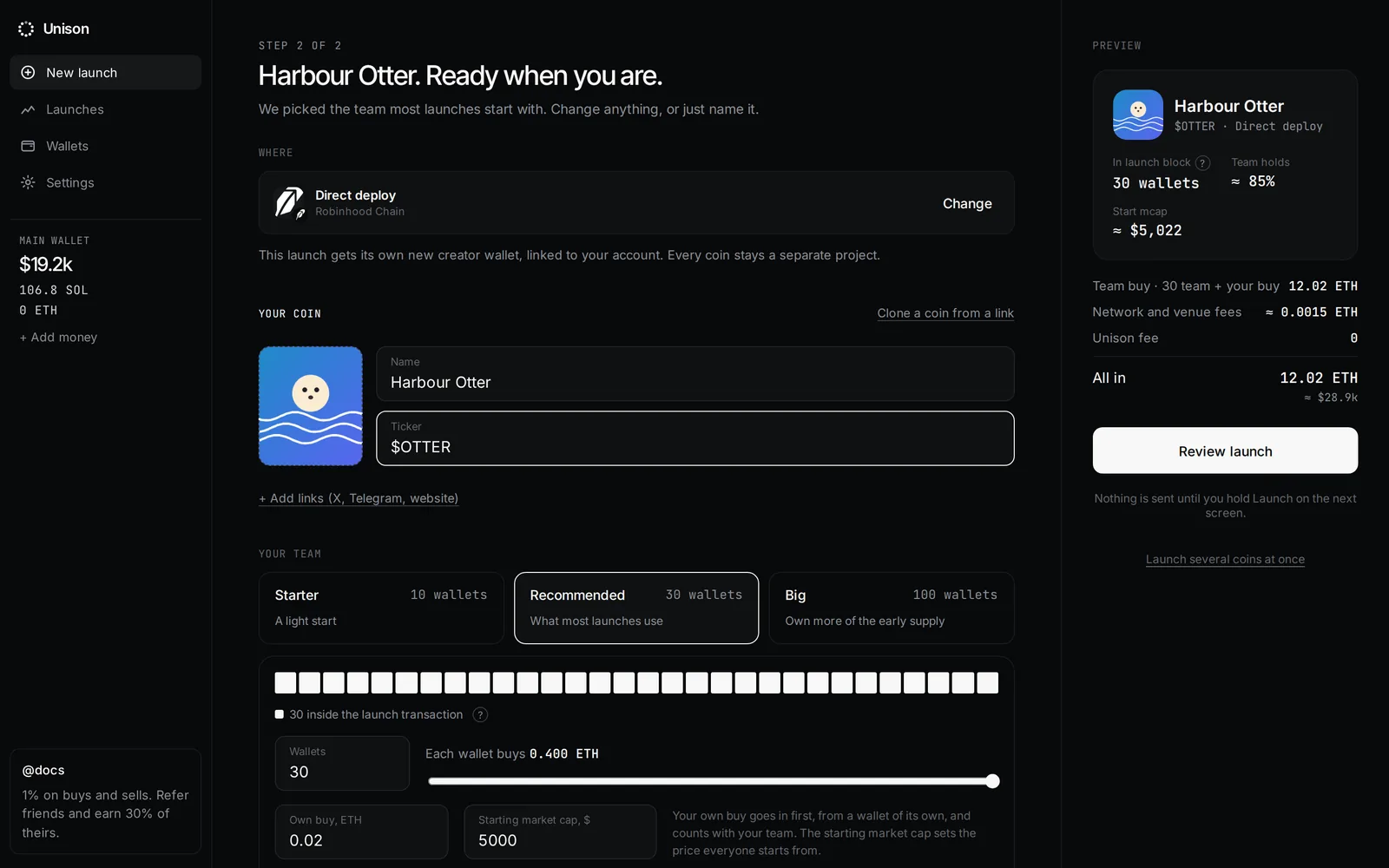
Pick Direct deploy, add the name, ticker and picture, set your own buy and the starting market cap ($5,000 by default, any value from $1). Up to 240 team wallets buy inside the launch transaction itself. That is verified on a mainnet fork (28 October 2026). The rest of the team buys right behind, on your timing. Unison is in closed beta.
What it costs
Gas only: no launchpad fee and no pool fee. Unison measured about 1.16 million gas for the launch plus about 94,200 gas per buy with eth_estimateGas on Robinhood Chain mainnet on 27 October 2026, against a cap of about 32 million gas per transaction. That cap is what limits the team to 240 buys with room to spare. The launch cost calculator adds it up for your team size.
What the data shows
Unison’s Robinhood Chain index saw 14,952 direct launches from 14 to 27 October 2026. 329 of them had 3 or more wallets receiving the coin in the transaction that opened trading. Those team launches put in a median of 5.2 ETH across a median of 5 wallets.
Team launches drew a median of 107 buyers, against 14 without a team. That is a correlation, not a cause: a team launch says nothing about whether outsiders will buy. Method and tables: Robinhood Chain team launches, October 2026.
Direct deploy (own Uniswap pool) at a glance
| Field | Value | Source |
|---|---|---|
| Chain | Robinhood Chain | Unison docs, direct deploy |
| Block time | About 100 ms, measured by Unison on its Robinhood Chain index. Robinhood’s docs give no block time | Unison launch study |
| Curve | None. A Uniswap v4 pool holds the whole supply from the first block | Unison docs, direct deploy |
| Total supply | 1,000,000,000 (18 decimals) on Unison | Unison docs, direct deploy |
| Creation cost | Network gas only. You pick the starting market cap (default $5,000) | Unison docs, direct deploy |
| Graduation | None: there is no curve to finish | Unison docs, direct deploy |
| Migrates to | None. The pool’s liquidity is burned at launch | Unison docs, direct deploy |
| Trading fee on the curve | 0%: the pool takes no fee | Unison docs, direct deploy |
| Creator share | None, because the liquidity is burned | Unison docs, direct deploy |
| Snipe protection | None built in. Team buys run inside the launch transaction itself | Unison docs, direct deploy |
| Fee after graduation | 0% pool fee | Unison docs, direct deploy |
| Buys that land with the coin | Limited by gas: about 94,200 gas per buy, and one transaction caps near 32M gas. On Unison: 240 team buys, verified on a mainnet fork | Unison, eth_estimateGas on Robinhood Chain mainnet |
Checked 12 Nov 2026. Every field, including the unverified ones: Direct deploy (own Uniswap pool) in the Launchpad Atlas.
Questions
Do I need a dev buy on a direct deploy?
Yes. On Unison your own buy is required on a direct deploy.
Can I pull the liquidity later?
No. The liquidity is burned at launch, so nobody can pull it.
Does a direct deploy pay creator fees?
No. The pool takes no fee, so there is nothing to pay out.
Why 240 wallets and not more?
One transaction on Robinhood Chain caps at about 32 million gas, and each buy costs about 94,200. 240 buys fit with room to spare.